Night trail running: headlamps, safety and fuelling
Lumens, battery life, backup light, cold and fuelling: how to prepare a night trail run or race, from the SaintéLyon to the UTMB, without nasty surprises.
To run trails at night you first need a bright enough headlamp (at least 400 lumens, according to the SaintéLyon organisers), enough battery for the whole night, and a backup light. Then come the cold, which drains batteries faster, and fatigue, which blunts your attention after midnight. The rest is practice: race night is not the time to find out how your lamp works.
This guide covers those points in order, whether you’re planning a winter run after work or a night race like the SaintéLyon.
What changes after dark
In daylight you read the ground several metres ahead without thinking. At night your field of vision shrinks to the beam of your lamp. Roots, rocks and ruts show up late, the terrain looks flatter than it is, and distances are hard to judge. You run slower for the same effort, and your concentration tires before your legs do.
None of that takes away the fun (watching the sun come up at the top of a climb after six hours under a headlamp is earned), but it does take preparation.
Choosing a headlamp
How many lumens?
Lumens measure how much light a lamp puts out. For the SaintéLyon, the advice article on the race’s official website recommends at least 400 lumens and mentions models that go past 1,000. That 400 figure works on runnable paths. The 2027 UTMB regulations we read set no minimum brightness at all. On technical singletrack or fast descents, more power helps you see further and react earlier.
More lumens isn’t always better, though. A very bright mode empties the battery quickly, and a strong beam in fog bounces straight back into your eyes. The ideal is an adjustable lamp: a moderate mode on easy sections, a high one for descents.
Reading spec sheets without getting caught out
Most brands test their lamps to the ANSI/PLATO FL1 standard, which defines three numbers:
- Lumens are the peak output just after switching on, with fresh batteries. Many lamps don’t hold it for long.
- Run time is measured until the output drops to 10% of the starting value. A lamp rated at 300 lumens counts as “empty” at 30 lumens, even though it still gives some light. Some brands add a “reserve” time beyond that.
- Beam distance is how far the beam still delivers 0.25 lux, which is very dim light.
In practice, a 10-hour run time on the highest mode almost never exists. Check the run time for the mode you will actually use, and whether the lamp offers “constant” lighting (output stays steady, then drops) or “standard” lighting (it fades gradually from the start).
Rechargeable or AAA?
A rechargeable battery is cheaper over time and often gives more power. AAA batteries have one big advantage: you can buy them anywhere and carry a spare set without needing a plug. Many “hybrid” lamps take both, which is handy for ultras.
Comfort matters
Over several hours, a lamp that bounces or a headband that pinches gets old fast. A battery pack at the back of the head balances the weight. Try the lamp while running, not just in the shop.
A backup light is not optional
A lamp can fail, break in a fall or run out earlier than planned. Being left without light on a trail in the middle of the night is dangerous.
The SaintéLyon organisers advise always starting with a spare headlamp or a backup battery, and testing both before the start. At UTMB Mont-Blanc, the 2027 regulations set a one-hour penalty on the UTMB, CCC and TDS for a runner carrying only one headlamp, and disqualification for none at all. According to u-Trail, the UTMB rules also require a full set of spare batteries for each lamp.
Even for a solo evening run, a small light lamp in your pack pocket weighs almost nothing.
Cold: your batteries’ worst enemy
Night races often fall in autumn or winter, and cold cuts battery life. The SaintéLyon article makes the point for its late-November race: in cold weather, batteries drain much faster.
A few simple habits:
- Keep the spare battery warm in an inside pocket, not at the bottom of your pack.
- Charge the lamp fully the day before, not a week earlier.
- Leave a margin: if you’ll spend eight hours running in the dark, don’t start with a lamp rated for eight hours in the mode you plan to use.
The cold affects you too. At night you run slower, so you produce less heat, and sweat chills you quickly when you stop. A warm layer and a windproof jacket in the pack, plus gloves and a hat, make all the difference at aid stations.
Seeing the ground
Where to point the beam
The SaintéLyon site recommends aiming the light at the ground 2 to 10 metres ahead while keeping your head up. Too close and you don’t see obstacles coming; too far and you miss the root right in front of your feet.
A waist or hand light
Some runners add a light at the waist or in the hand. Held lower, it casts shadows that show the shape of the ground better than a headlamp alone. It’s a useful extra on rough terrain.
Shoes
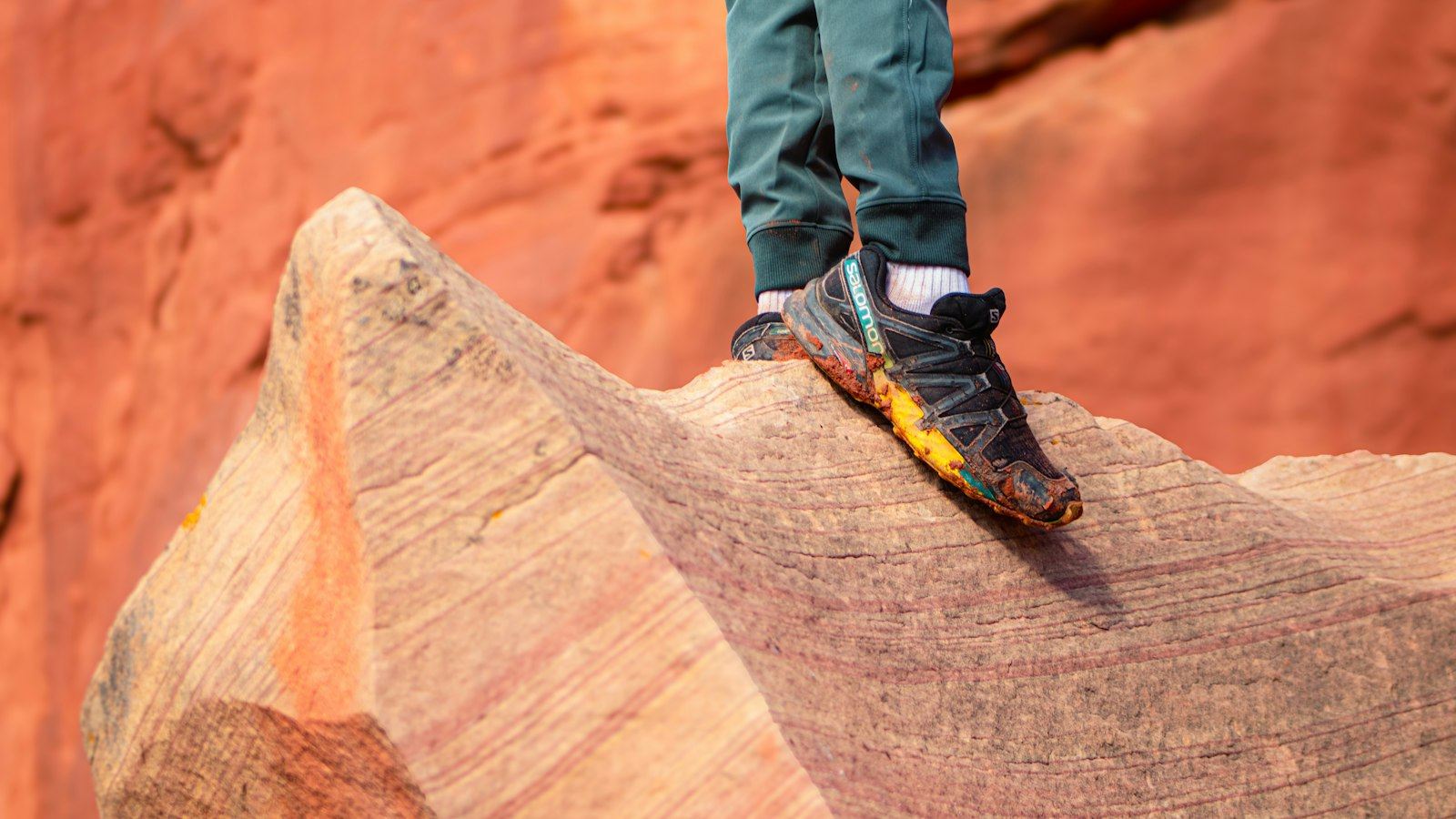
On a poorly lit trail, grip and protection matter even more. Good lugs and a sole that shields you from rocks reduce the nasty surprises. Our guide on how to choose trail running shoes goes through these criteria.
Safety: be visible and tell someone
- Tell someone your route and expected return time when you run alone.
- Carry a charged phone. It’s mandatory at UTMB, and the organisers ask runners never to switch it to airplane mode during the race.
- Be visible on road sections: reflective strips on your clothing, and possibly a small red light at the back.
- Know your route. Reflective markers show up well at night, but a missed junction costs time quickly. A GPS track loaded on your watch helps a lot.
- When you pass someone, tilt your head down or dim the lamp so you don’t dazzle them.
Eating and drinking at night
Night throws off your habits. You feel less hungry, you forget to drink because it’s cool, and sleepiness can hit around 3 or 4 in the morning. The effort carries on all the same, and so do your needs.
The simplest approach is to eat on a schedule rather than by feel, for example every 30 to 45 minutes, using food you’ve already tested in training. Same for water: drink before you feel thirsty, since the cold hides it. If the aid stations serve soup or a hot drink, take it; it lifts your mood as much as your temperature.
As for the late-night slump, nearly everyone gets it. Slowing down for a few minutes, eating a little and keeping moving is often enough to get through it.
Train at night before race day
Before a night race, do a few runs with a headlamp on trails you know by day. You’ll learn to manage your lighting and your pace, and spot what bothers you (headband, fogging, glare).
Test your full race-day kit as well: lamp, backup battery, clothing and food. A long run that starts in the late afternoon and finishes in the dark lets you experience the switch from day to night, often the most disorienting moment.
Pre-run checklist
| What to bring | Why |
|---|---|
| Adjustable headlamp, at least 400 lumens | See far enough and save battery |
| Run time checked for the mode you’ll use | Peak figures are misleading |
| Backup lamp or battery | Failure, breakage, cold |
| Spare battery kept warm | Cold drains batteries |
| Warm layer, windproof, gloves | You cool down fast at night |
| Charged phone, someone informed | Safety if you’re alone |
| Fuel on a schedule | Appetite and thirst drop at night |
Before any race, read the event rules: the mandatory kit list changes from one race to another and from one year to the next. The SaintéLyon list is in each race’s regulations, available from your runner account.
Sources
- SaintéLyon (official site): running at night, how to be well lit on race day
- SaintéLyon: practical info (mandatory kit listed in each race's rules)
- UTMB Mont-Blanc: 2027 regulations (penalties for a missing headlamp)
- UTMB Mont-Blanc: safety guidelines (mandatory phone)
- u-Trail: UTMB rules on mandatory lamps and batteries (11 March 2025)
- Petzl: how lighting performance is measured under the ANSI/PLATO FL1 protocol
- REI: understanding headlamp brightness (FL1 standard)